Morocco price cap: Aïd al-Adha decree tests enforcement

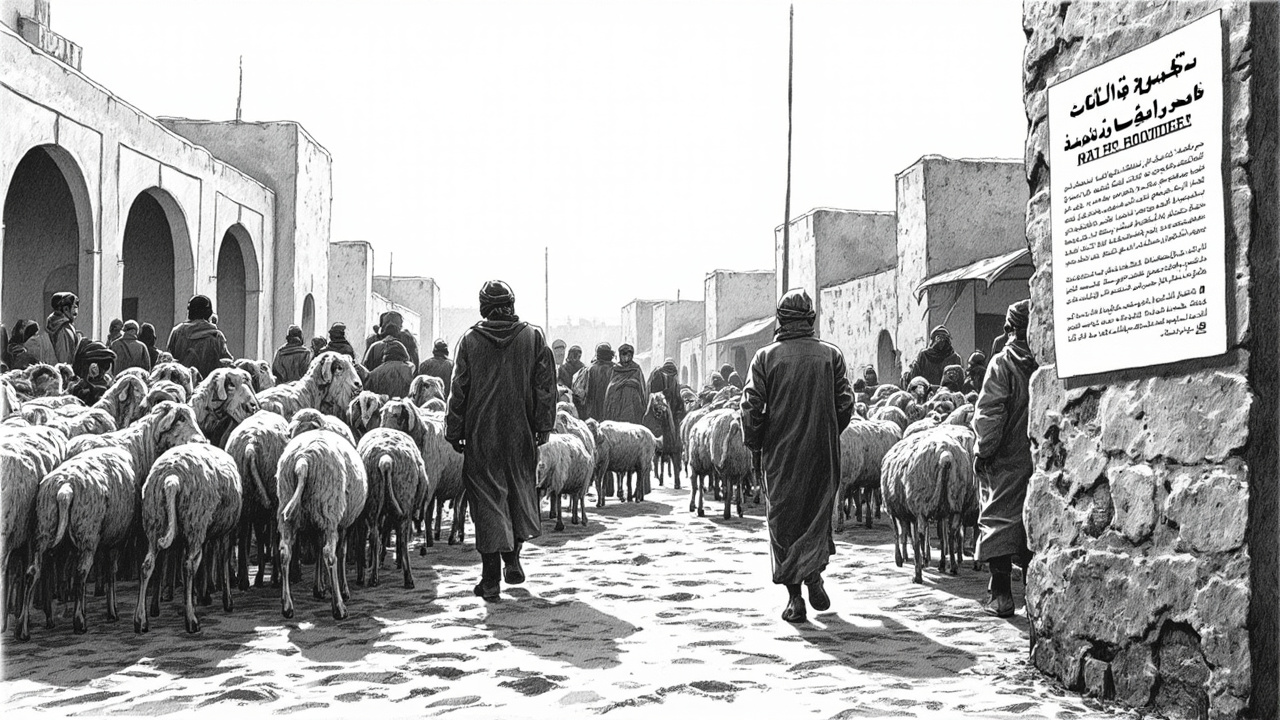
Morocco's government wants to cap livestock prices ahead of Aïd al-Adha. The decree landed Monday, less than four weeks before the holiday. That timing tells you everything about the political calculus.
The decree's mechanics
Prime Minister Aziz Akhannouch promulgated the measure on May 18, 2026, invoking laws on commune organization and price freedom. The stated goal: preserve purchasing power and ensure transparent animal markets. The decree gives authorities the power to set maximum prices for sacrificial animals and to penalize hoarding or speculation.
But here's the catch. Morocco's livestock market is largely informal. Small breeders sell directly at weekly souks. The government does not have the staff or the systems to monitor thousands of scattered transactions. According to Atlasinfos coverage, the decree applies to commercial points of sale, registered dealers and large livestock markets. That still leaves the vast majority of animal sales outside formal oversight.
The real enforcement question is political. Akhannouch made statements in Parliament on April 23, 2026, that sparked debate about breeder behavior and pricing. Medias24 reported that his remarks were seen as blaming farmers for high prices. The decree looks like a response to that blowback, a gesture to consumers rather than a serious regulatory overhaul.
The demand signal
Here's the number the government does not want to talk about. As of May 14, demand for sacrifice animals was described as "timid" by market sources. Consonews interpreted that as a clear sign of weakened purchasing power. Moroccans are not buying because they cannot afford the animals. A price cap will not fix that core problem.
It gets worse. If the cap is set below what breeders need to cover costs, they will hold animals off the market. That creates scarcity. Scarcity pushes up black-market prices. The net result: the people who need price relief most, low-income urban households, either pay more informally or skip the sacrifice altogether. The government loses credibility. Farmers lose income. Nobody wins except the middlemen who can navigate both markets.
What investors should watch
Investors in Morocco's agriculture and food sectors should watch three things.
First, the degree of actual enforcement. If the government makes a few high-profile seizures but does not follow through, the decree is noise. If it starts fining traders aggressively, expect supply disruptions and a temporary price spike.
Second, the black-market premium. Track prices in informal souks versus official markets. A widening gap signals that the cap is binding but ineffective. That is the worst outcome: political capital spent, producers hurt, consumers no better off.
Third, the political calendar. Morocco has municipal elections looming. A successful price squeeze before Aïd al-Adha would be a gift for the ruling coalition. A failed one, empty markets, angry voters, would be a liability. Expect the government to impose the cap stringently in urban centers and look the other way in rural areas. That is the pattern from past price control experiments in Morocco.
The bottom line: this decree is a political stopgap, not a structural fix. Morocco's livestock market needs transparency, cold-chain investment, and formal credit mechanisms, not last-minute price orders. Investors should factor in a one-off volatility spike, not a long-term regulatory shift.